
On 16 March 2026, the Ministry of Labor published the draft bill reforming Law 31/1995. For the first time, psychosocial risks carry the same legal weight as physical, chemical, or ergonomic risks. Your company has new obligations — and some take effect before the text becomes law.
Here is what changes, what you need to do, and where to start.
What psychosocial risks are and why they now matter legally
Chronic stress, excessive mental load, harassment, algorithmic performance pressure: until now, your OHS officer could mention these factors in the assessment or ignore them without clear legal consequences. The draft bill closes that door.
The new text expands the concept of work-related harm to six dimensions: physical, physiological, cognitive, emotional, behavioral, and social. Assessing only physical risks is no longer sufficient — and once the law comes into force, it will no longer be legal.
Furthermore, the text explicitly recognizes violence and harassment exercised through algorithms or artificial intelligence systems as risks that the company must prevent. A change that directly affects industrial environments with performance monitoring systems.
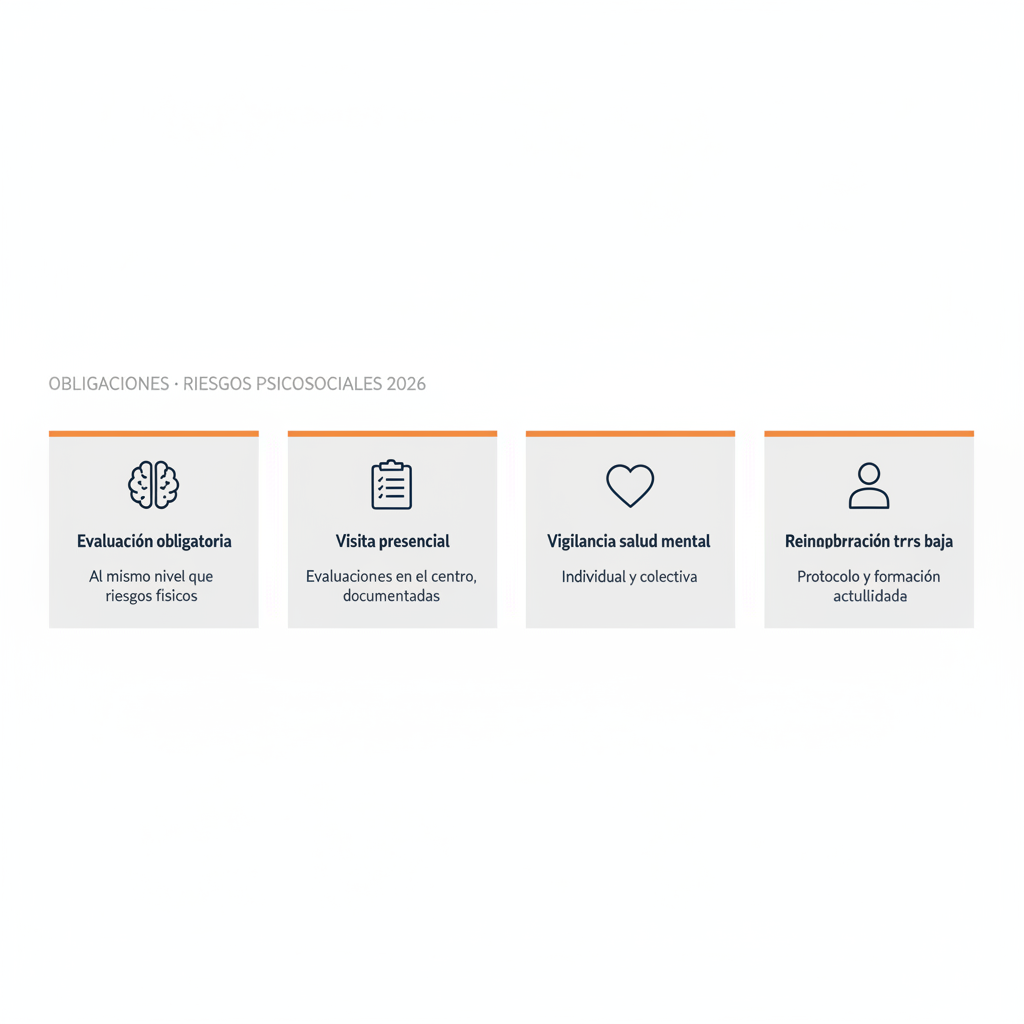
The three concrete obligations the reform introduces
The draft bill goes beyond declarations. These are the operational requirements that affect your prevention system:
Include psychosocial risks as a mandatory category in the risk assessment, at the same level as safety, hygiene, and ergonomics.
Review the assessment whenever the work organization, processes, or procedures change — not only when equipment or facilities change.
Conduct assessments through on-site visits to workplaces, with procedures that demonstrate real contact with operations.
The third point deserves particular attention. The Ministry is targeting documentary assessments that never set foot in the plant. If your risk assessment was written by someone in an office without visiting the site, you need to review it.
Mental health: from recommendation to requirement
The UN declared mental health a global priority in February 2026. The Spanish draft bill reflects this specifically: companies must guarantee monitoring of both physical and mental health, individually and collectively.
In practice, this means:
Health checks at the start of employment, periodic checks, and checks after prolonged health-related absences.
Collection of exposure and harm data for analysis to prioritize preventive measures.
Return-to-work procedures after long absences, including role adaptation and training updates.
For industrial plants with rotating shifts, night work, or high physical demands, these three points mean redesigning the health monitoring protocol you have probably been using unchanged for years.
Algorithmic harassment: a new category affecting industry
This is the least discussed change and one of the most relevant for industrial environments with performance control systems.
The draft bill recognizes harassment exercised through information technologies, algorithms, or artificial intelligence systems as an occupational risk that the company must prevent. If you use productivity monitoring systems, tracking cameras, or automated performance alerts, you must include their psychosocial impact in the risk assessment.
This is not a ban on using that technology. It is an obligation to assess whether it generates psychological pressure on workers and, if so, to take action.
Gender and age perspective: no longer optional
The draft bill turns into a legal obligation something that until now was a recommendation: integrating gender and age perspectives into preventive management.
Your OHS manager must consider that the same post may carry different exposures depending on who occupies it. PPE, physical load limits, and procedures must be adapted to the current characteristics of each worker — not to the standard worker profile.
What to do before the law comes into force
The draft bill is in public consultation until April 8. Parliamentary proceedings will take months. But waiting for approval to act is the most costly mistake your prevention team can make.
These are the five actions with the most immediate impact:
Audit whether the current risk assessment includes psychosocial risks as a standalone category with associated measures.
Verify that the most recent assessments were conducted with documented on-site visits.
Review the health monitoring protocol: does it include mental health? Does it cover return-to-work after sick leave?
Analyze whether performance monitoring systems generate measurable psychological pressure on workers.
Check that the PPE is sized for all worker profiles, not just a standard profile.
Companies that treat this reform as a compliance problem will arrive late and at a higher cost. Those who read it as an opportunity to improve their preventive system will arrive sooner and with less friction.
How computer vision helps manage psychosocial risks
Detecting fatigue, stress postures or risky behaviors in real time is exactly what computer vision does in industrial environments. Safe monitors behaviors, generates early alerts and produces the documentary record that the new regulations will require.
It does not replace the ORP technician. It gives you concrete data so you can make decisions with evidence, not intuition.
Discover how Safe manages psychosocial risks in the plant in real time